
Many parents think this, even if they never say it aloud.
After an autism diagnosis, the uncertainty about the future can feel overwhelming. The hardest part is often not knowing what the future will look like.
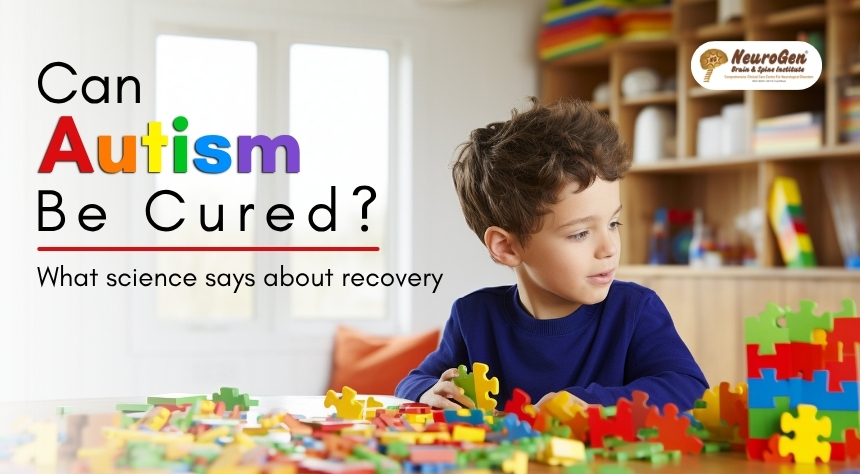
Questions about school, independence, communication, and long-term outcomes start to surface quickly. One of the most common questions is simple: Can autism be cured?
In a world where modern medicine has treated complex diseases, it is natural to hope for a permanent solution. But autism is different.
To understand why, we need to look at what autism represents from a neurological and scientific perspective.
What Is Autism Spectrum Disorder?
Autism spectrum disorder, or ASD, is a neurodevelopmental condition. It affects how the brain develops and influences communication, social interaction, behaviour, and sensory processing.
Autism begins early in life. Research shows that genetic and biological factors play a major role in brain development in individuals with autism. It is not caused by parenting style, emotional stress, or a single event.
The term “spectrum” reflects variation. Some individuals require significant daily support. Others live independently but may experience social or sensory differences.
Autism is not classified as a disease. It represents a pattern of brain development that begins early and continues throughout life. Some areas of the brain do not function properly.
Because of this, the concept of a medical cure must be understood carefully.
Why Isn’t Autism Considered Curable?
In medicine, a cure means that a condition can be completely eliminated and no longer affects the person. This typically applies to infections, certain deficiencies, or some structural problems that can be corrected.
Autism does not fit that definition.
Clinical Insight: From a neurological perspective, autism reflects early brain development patterns that cannot be reversed. Clinical focus is therefore placed on improving functional abilities and long-term independence.
Autism is considered non-curable for several scientific reasons:
- It begins during early brain development, often before birth.
- It involves differences in how parts of the brain communicate and process information.
- Genetic and biological factors contribute to how the brain is wired.
- It is not caused by a single reversible process.
- It is lifelong, even though its expression may change over time.
A cure would require reversing early neurodevelopmental patterns that shape how the brain organizes communication, social understanding, and sensory responses. Current medical science does not have a way to erase or reprogram these foundational brain differences.
However, ‘non-curable’ does not mean ‘untreatable’. It means that the focus shifts from eliminating autism to supporting development and overall quality of life, helping individuals build skills that allow them to participate more fully and productively in daily life.
For many families, understanding this difference can bring clarity, even if it does not immediately bring comfort.
Can Autism Symptoms Improve Over Time?
Yes, autism symptoms can improve over time. However, improvement does not mean that autism disappears. It means that certain challenges become more manageable or less pronounced.
Research shows that early and structured interventions can significantly influence developmental progress. The brain in early childhood has high neuroplasticity, meaning it can adapt and form new connections in response to learning and experience.
Improvements are often seen in areas such as:
- Language and communication skills
- Social interaction and eye contact
- Emotional regulation
- Adaptive and daily living skills
- Behavioral flexibility
Some individuals may no longer meet the full diagnostic criteria for autism later in life. This is sometimes referred to as “optimal outcome” in research settings. However, subtle differences in social processing or sensory sensitivity may still remain.
Progress varies widely. Every child’s developmental path is unique, and outcomes cannot be predicted by a single label.
Factors that influence outcomes include:
- Early identification
- Access to therapy
- Intellectual ability
- Coexisting medical or developmental conditions
- Family and environmental support
Improvement is possible and well documented. The goal of intervention is to strengthen functional abilities, not to erase neurodevelopmental identity. This is often supported through a structured autism therapy approach designed around a child’s unique strengths and challenges, helping them gradually develop everyday skills.
For many parents, seeing gradual progress over time becomes more meaningful than the idea of a cure.
What About Claims That Autism Can Be Reversed?
In scientific literature, the term “reversal” is not commonly used for autism. Instead, researchers may describe:
- Significant improvement in symptoms
- Children who no longer meet full diagnostic criteria
- Positive response to intensive early intervention
These situations are uncommon and do not represent a universal outcome. Even when individuals no longer meet formal criteria, subtle differences in social communication or sensory processing may still exist.
It is also important to distinguish between:
- Small research studies and large population data
- Animal model experiments and human clinical evidence
- Anecdotal reports and controlled scientific trials
Media headlines sometimes simplify complex research findings. A laboratory discovery or a single case report does not mean that autism can be reversed in the general population.
At present, there is no high-quality scientific evidence showing that autism can be completely reversed or permanently removed. What research does support is early intervention, structured therapy, and individualized support as pathways to meaningful improvement.
Research does support is early intervention, structured therapy, and individualized support as pathways to meaningful improvement.
Understanding this difference protects families from unrealistic expectations and allows decisions to be guided by evidence rather than promises.
What Should Parents Focus On Instead of a Cure?
When the focus shifts away from finding a cure, it becomes easier to concentrate on what truly makes a difference in a child’s development.
The most productive approach is to focus on growth, skills, and long-term independence.
Key priorities often include the following:
- Strengthening communication, whether verbal or alternative methods
- Building social understanding and interaction skills
- Supporting emotional regulation
- Developing daily living and self-care abilities
- Encouraging learning through structured educational support
Early intervention plays a critical role. The earlier supportive therapies begin, the greater the opportunity to build foundational skills during periods of high brain adaptability.
Equally important is individualized planning. Autism presents differently in every child. A strategy that works well for one individual may not be effective for another. A comprehensive evaluation helps identify strengths, challenges, and specific areas that need support.
Families also benefit from reliable information and coordinated care. Working with qualified professionals ensures that decisions are guided by evidence rather than trends or unverified claims.
The goal is not to change who a child is. The goal is to help them communicate, function, and participate in life with confidence and support.
Key Takeaways
- Autism is not considered a curable condition, as it reflects early brain development differences.
- A medical cure means complete removal of a condition. Autism does not fit this definition.
- Improvement is possible with early and structured support.
- Progress does not mean autism disappears, but challenges may become more manageable.
- There is no scientific evidence supporting complete reversal of autism.
- Early intervention and therapy play a key role in development.
- Outcomes vary for each individual based on multiple factors.
- The focus is on improving quality of life and building meaningful life skills.
Frequently asked questions
Is autism permanent?
Autism is considered a lifelong neurodevelopmental condition. Its presentation may change with age, but underlying differences in brain development remain.Can a child outgrow autism?
Some individuals may no longer meet full diagnostic criteria as they grow older, especially after early intervention. However, subtle traits or developmental differences may still be present.Are there any proven medical cures for autism?
No medical treatment has been proven to cure autism. Current approaches focus on therapy, support, and skill development.Can therapy reduce autism symptoms?
Yes. Behavioral, speech, occupational, and educational interventions can significantly improve communication, social interaction, and adaptive skills in individuals with autism. In addition, regenerative medicine has emerged as a promising treatment approach, with many children showing improvements in cognition, behavior, communication, and overall functional abilities when integrated into a comprehensive treatment plan.How to cure autism spectrum disorder?
Autism spectrum disorder currently has no universally established cure, but several treatment approaches can help improve a child’s development and quality of life. Along with behavioral therapy, speech therapy, and occupational therapy, regenerative medicine has emerged as a promising treatment option, with studies and clinical experience showing improvements in communication, social interaction, behavior, and daily functioning in many children. While outcomes can vary, ongoing advances in this field offer growing hope for families seeking broader treatment possibilities.
Conclusion
Autism is not considered curable because it reflects early patterns of brain development rather than a disease that can be removed. However, improvement is possible, and in many cases significant progress can occur with early and structured intervention.
The most meaningful outcomes in autism care come from focusing on communication, learning, adaptive skills, and long-term independence. Science supports intervention, guidance, and individualized planning. It does not support promises of quick cures.
When families understand this distinction, decisions become clearer. The goal shifts from searching for elimination to building capability and confidence over time