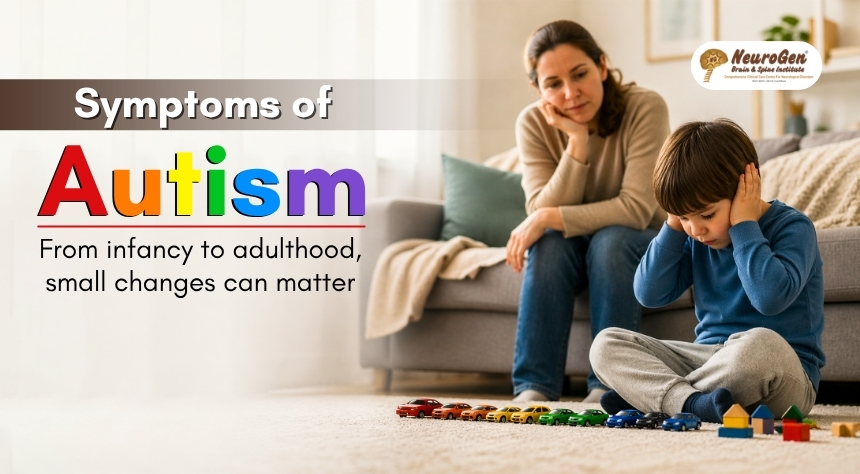

Many parents describe it as a quiet feeling that something is different, even if they cannot name it yet. A child may not respond to their name, or a toddler may line up toys instead of playing. These small, repeating moments often lead to the first question: could this be autism?
Autism does not always appear in obvious ways. Some signs show up early, while others become clearer as social and communication demands grow. In many cases, especially in girls, signs may remain hidden for years.
Autism presents differently at each stage of life. Understanding how these patterns appear over time can help you recognize what to look for.
Quick Summary
- Autism symptoms involve differences in communication, social interaction, behavior, and sensory responses
- Signs can appear from infancy and continue across childhood into adulthood
- Many early signs are subtle and may be mistaken for personality traits or developmental delays
- What matters most is a consistent pattern across multiple areas over time
- Early understanding and timely support can help guide the right next steps
What Are the Symptoms of Autism Spectrum Disorder?
Autism symptoms are differences in communication, social interaction, behavior, and sensory processing that appear across a person’s development. These signs vary from person to person and may range from mild to more noticeable patterns.
Key areas where autism symptoms appear:
- Social interaction: Difficulty understanding social cues, building relationships, or connecting emotionally
- Communication: Delayed speech, limited gestures, or difficulty understanding tone, humor, or implied meaning
- Behavioral patterns: Repetitive movements, strong routines, intense interests, and resistance to change
- Sensory responses: Increased or reduced sensitivity to sounds, textures, lights, or other sensory input
Autism is called a spectrum condition because no two individuals experience these signs in the same way. Some may need more support in daily life, while others may function independently but still face specific challenges.
No single sign confirms autism. What matters is a consistent pattern across these areas that affects everyday functioning, something best understood through a professional assessment.
Autism Symptoms at a Glance
Social Signs
- Difficulty making or maintaining eye contact
- Little interest in playing or spending time with peers
- Trouble understanding how others feel or what they are thinking
- Missing social cues like facial expressions or body language
- Unusual responses to affection, either pulling away or seeking it excessively
Communication Symptoms
- Delayed speech or language development
- Repeating words or phrases (echolalia) without clear meaning in context
- Taking language very literally, so sarcasm, idioms, and jokes often land flat
- Limited use of gestures like pointing or waving
- Losing language skills that were already developing
Behavioral Patterns
- Repetitive movements like hand-flapping, rocking, or spinning
- Strong need for routines, with real distress when they get disrupted
- Intense, narrow interests focused on specific topics or objects
- Lining up toys or objects in a precise order
- Difficulty switching between activities
Sensory Symptoms
- Over-sensitivity to sounds, lights, textures, or smells
- Under-sensitivity, appearing unfazed by pain, heat, or loud noise
- Distress from specific clothing textures or food consistencies
- Seeking sensory input through spinning, pressing against surfaces, or mouthing objects
What Are the Early Signs of Autism in Infants?
Early signs of autism can appear within the first six months, often before a formal diagnosis is possible. These signs are usually subtle, but recognizing patterns early can help guide timely support.
Newborns (0-3 Months)
- Limited or no eye contact, even during feeding
- Does not focus on or follow the caregiver’s face
- No social smiling in response to a parent’s smile
- Little to no reaction to familiar voices or sounds
Infants (3-12 Months)
- Does not turn or respond to their name by 6-9 months
- No babbling or cooing by 6 months
- Rarely shows joy, curiosity, or surprise through facial expressions
- Does not point, wave, or gesture by 10-12 months
- No back-and-forth exchange of sounds or smiles with a caregiver
Physical and Sensory Signs
- Unusual muscle tone, either notably stiff or unusually floppy
- Strong distress at normal household sounds
- Pulls away from being held or cuddled
- Strongly drawn to lights, fans, or repetitive visual patterns
What Are the Signs of Autism in Toddlers (1-3 Years)?
As language and social skills develop, differences become more noticeable.
Communication Delays
- No single words by 16 months
- No two-word phrases by 24 months
- Loses words or language skills that were already developing
- Uses gestures or pulls adults by the hand rather than speaking
- Repeats phrases from TV shows without using them meaningfully
Behavioral Signs
- Repetitive movements such as rocking, spinning, or hand-flapping
- Intense focus on specific objects like wheels, fans, or lights
- Lines up toys or objects rather than playing with them imaginatively
- Becomes very distressed over small changes in routine
- Unusual reactions to sensory experiences like textures, sounds, or temperatures
Social Interaction Signs
- Little interest in other children, may walk past peers as if they are not there
- Does not join in shared or cooperative play
- Rarely points to share excitement or interest in something
- Does not follow when someone else points at something
- Seems to prefer objects over people
What Are the Symptoms of Autism in Children (4-12 Years)?
As social expectations increase, signs often become clearer.
Social and Emotional Signs
- Struggles to understand the unspoken rules of friendship
- Has trouble reading facial expressions, body language, or tone of voice
- Often says the wrong thing in social situations, not from rudeness but from missing the cue
- Finds it hard to see things from another person’s point of view
- Emotional reactions that seem bigger than the situation calls for
Communication Signs
- Speaks very literally, so sarcasm, metaphors, and jokes often go over their head
- Talks at length about their interests without noticing the other person checking out
- Struggles with the natural back-and-forth of conversation
- Uses unusually formal or adult-sounding language for their age
Behavioral and Sensory Signs
- Gets visibly distressed when daily routines change unexpectedly
- Has one or two intense interests that dominate most of their attention and conversation
- Finds the classroom sensory environment overwhelming, whether from noise, lighting, or crowded spaces
- Has meltdowns or emotional shutdowns under stress, which are different from typical tantrums
- Finds it hard to shift between subjects, tasks, or activities
What Are the Signs of Autism in Adults?
Some individuals are not identified until adulthood, especially if they have learned to mask their traits.
Social and Communication Signs
- Finds small talk or unplanned social interaction genuinely draining
- Prefers structured, predictable conversations over spontaneous ones
- Struggles with the unwritten rules of the workplace or social groups
- Finds eye contact uncomfortable, or has learned to fake it over the years
- A history of friendships that felt one-sided or ended without a clear reason
Female Autism Signs
Autism in women is one of the most underdiagnosed conditions in healthcare. Girls learn early to imitate, adapt, and mask, which means their signs often stay buried. If you are a woman who has always felt different but could never put your finger on why, it may be worth exploring. Common signs include:
- Copying others’ social behavior to appear more natural
- Wanting to connect socially but finding it deeply draining
- Getting a diagnosis of anxiety, depression, or an eating disorder before autism comes up
- A persistent sense of not fitting in, even when no one else can see why
- Feeling emotionally exhausted after social events, even ones that seemed to go well
Behavioral and Sensory Signs
- A strong need for routine and real difficulty when plans change
- Deep, specialized interests that feel like a core part of who you are
- Avoiding certain foods, fabrics, or environments because they feel too intense
- Needing time alone to recover after being around people
- Periods of burnout that are hard to explain to anyone around you
Can Autism Symptoms Be Confused with Normal Behavior?
Yes. Many behaviors overlap with typical development. The difference lies in consistency, intensity, and impact on daily life.
| Typical Development | Autism Pattern |
|---|---|
| Prefers playing alone occasionally | Consistently avoids interaction, even when encouraged |
| Dislikes routine changes at times | Strong distress with even minor changes in routine |
| Shy in new situations | Ongoing difficulty understanding social cues across situations |
If you are unsure whether what you are seeing falls within typical development, a developmental specialist can give you a clear, honest picture.
What Are the Subtle Signs of Autism That Are Often Missed?
Not every sign of autism shows up in a classroom or at a birthday party. Some of the most commonly missed signs are quieter and more internal, and because they do not cause disruption, they fly under the radar for years.
- Appears to be listening but rarely retains what was said
- Takes even gentle criticism very hard, as feedback feels devastating rather than helpful
- High anxiety in social situations with no obvious cause
- Mentally rehearses conversations before they happen
- Feels deeply for animals or fictional characters but struggles to connect with real people
- Feels completely drained after social events, even short or casual ones
- Reads fluently very young but struggles to understand the meaning behind the words
Real-Life Signs Parents Often Notice
Checklists capture patterns, but they do not always reflect how those patterns actually look at home. Parents often remember specific, vivid moments that turned out to be meaningful, moments they had brushed aside at the time.
“He walked on his toes everywhere, even at home. We thought it was just a habit. It was years before we connected it to sensory processing.”
“She could name every country’s capital by four years old, but had no idea what her best friend’s favourite colour was.”
“Birthday parties always ended the same way, not a tantrum, just silence. She would completely shut down and stop responding.”
These signs may seem small in isolation. What makes them significant is when they keep showing up across different settings and over time. If something keeps coming back to you, trust that instinct.
What Are the Early Red Flags of Autism You Should Not Ignore?
Some developmental signs are strong enough that they warrant prompt evaluation on their own. These are not reasons to panic. They are reasons to act sooner rather than later.
- No social smiling by 6 months
- No babbling by 12 months
- No pointing, reaching, or waving by 12 months
- No single words by 16 months
- No two-word phrases by 24 months
- Any loss of language or social skills, at any age
- No consistent response to their name by 12 months
At this stage, a structured evaluation becomes important. Starting support during the early developmental window can make a profound and lasting difference in a child’s life.
Quick Checklist: Signs of Autism You Should Not Ignore
- Does not consistently respond to their name
- Avoids or has very limited eye contact
- Does not point to share interest or excitement
- Unusual or absent babbling and early speech
- Repeats words or phrases without clear purpose
- Intense distress over small changes in routine
- Repetitive body movements such as rocking, hand-flapping, or spinning
- Fixation on specific objects or topics to an unusual degree
- No imaginative or pretend play by age 2-3
- Over- or under-sensitivity to sensory input
- Regression in previously learned skills or milestones
- Difficulty making or keeping friendships
At What Age Do Autism Symptoms Usually Appear?
In most cases, early signs of autism show up before 18 months, and sometimes as early as 6 months. For many children, things become clearer between ages 2 and 4, when social and language expectations start to climb. For girls and those who mask well, autism may not get picked up until school age, adolescence, or adulthood.
If you are wondering whether your child is too young, or whether it is too late for an adult, a developmental evaluation is worth pursuing at any age.
Do Autism Symptoms Change Over Time?
Yes, often significantly. Autism is not a fixed, unchanging condition. Some signs become less prominent with the right support, while others may shift in how they appear over time. For example, a child with early speech delays may develop strong verbal skills by school age, yet still experience differences in social communication.
This often leads many families to explore whether autism can be cured or managed over time. In reality, autism is a lifelong condition, but with the right understanding, tools, and support, it can be managed effectively over time. Many autistic individuals build meaningful skills, discover their strengths, and learn to navigate life in ways that work for them.
When Should You Seek Help for Autism Signs?
You do not need to be certain before reaching out. If you have been reading through this and something keeps resonating, that feeling is worth following up on. Consider seeking an evaluation if:
- Your child is missing one or more developmental milestones
- You have noticed a regression in skills they previously had
- Behavioral or sensory challenges are affecting your family’s daily life
- Your child is struggling socially at school or with peers
- A teacher or caregiver has raised concerns
- You are an adult who has always felt different and is finally looking for clarity
Speaking with a specialized autism treatment centre means your questions reach people who understand the full spectrum, not just the textbook version of it. A proper evaluation does not just provide a diagnosis. It opens the door to the right support.
How Therapy Helps Manage Autism Symptoms and Improve Daily Life
A diagnosis is a starting point, not a ceiling. Once autism is identified, a range of therapy approaches for autism can be explored, each built around what children actually need.
- Applied Behavior Analysis (ABA): Structured, evidence-based programming that builds skills.
- Speech and Language Therapy: Supports communication development, social language, and the ability to express needs and ideas clearly.
- Occupational Therapy: Helps manage sensory sensitivities and builds daily living skills.
- Social Skills Training: Develops social interaction abilities with confidence.
Starting early makes the biggest difference. The goal is never to change who a person is. It is to give them the tools to live more fully as themselves.
Key Takeaways: Understanding Autism Signs Across Ages
- Autism presents differently at each stage of life, from subtle early signs in infancy to more visible patterns later
- Not all signs are obvious, and some may be overlooked or misunderstood for years
- Patterns that are consistent, intense, and impact daily functioning are more important than isolated behaviors
- Signs may change or evolve over time, especially with the right support and guidance
- Recognizing these patterns early can help individuals and families move toward the right support with more clarity
Frequently asked questions
Can autism be detected early in life?
Yes, in many cases, early signs can be noticed within the first year. You might see small differences in how a child responds to people, makes eye contact, or communicates. These signs are often subtle at first, but become clearer over time as social and communication skills develop.
Do autism symptoms vary from person to person?
Yes, they can vary quite a bit. Autism is a spectrum condition, which means each individual may show different signs and at different levels. Some may have noticeable challenges, while others may have milder or more subtle differences.
Can mild autism go unnoticed?
Yes, it can. In some children and adults, the signs may not be very obvious, especially if they’ve learned to adapt or mask certain behaviours. This is one reason why some individuals are identified later in life.
Do symptoms improve with age?
In many cases, children do show improvement over time, especially with the right support and guidance. Skills like communication, interaction, and daily functioning can gradually develop, although progress may look different for each person.
Can autism symptoms be mistaken for normal behaviour?
Yes, especially in the early stages. Some signs may look like typical developmental variations or personality traits. The key difference is whether these patterns are consistent over time and affect everyday interaction or communication.
Need Guidance on the Next Steps?
If something in this guide resonates with you, it is worth exploring further. You do not need all the answers before reaching out.
Getting clarity early can make a meaningful difference. A professional assessment helps you understand what you are seeing and what steps to take next.
Speaking with a trusted specialist is often the simplest and most reassuring first step.