
If you have recently heard the word autism in connection with your child, one question usually comes first: why?
The honest answer is that autism does not have one single confirmed cause. Decades of research point to something more layered. Autism develops through a combination of genetic, neurological, developmental, and environmental influences that shape how a child’s brain grows. These factors interact differently in every child, which is part of why autism looks so different from one person to the next.
Nothing a parent did, or didn’t do, makes a child autistic. That is worth saying clearly, because it is often the quiet worry sitting underneath the question.
This guide walks through what science currently understands about the causes of autism, what it has ruled out, and what remains under active study.
Quick Summary
- No single cause. Autism develops from a mix of genetic, neurological, and environmental influences shaping early brain development.
- Genetics is strongest. Twin and family studies suggest 40 percent of autism risk traces to genes.
- Some causes are well established. Others remain under study. A few popular theories have been ruled out entirely.
- Earlier is better. Early identification opens access to support during the brain’s most adaptable years.
- Parenting and screen time do not cause autism.
- Earlier identification leads to better outcomes through timely support.
What Causes Autism?
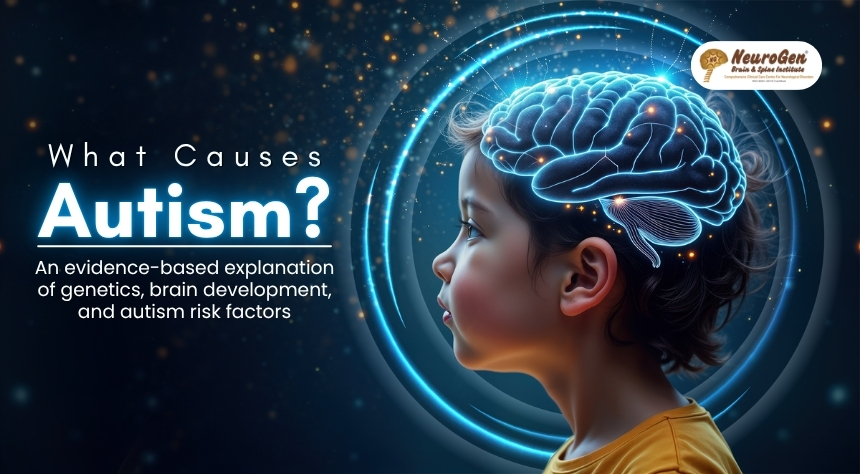
Autism spectrum disorder (ASD) is a complex neurodevelopmental condition. It relates to how the brain develops and organizes itself, beginning very early in life, often before a child is even born.
There isn’t one cause that explains every case. Several factors can contribute, sometimes alone, sometimes in combination. Genetics plays the strongest role. Brain development patterns play another important role. Certain prenatal and environmental conditions can influence risk in specific situations.
Main Factors Linked to Autism
- Genetics. The strongest contributor, estimated to account for 40 percent of autism risk across hundreds of genes.
- Brain development. Neurological connections form along different patterns from very early in life.
- Prenatal factors. Certain conditions during pregnancy and birth can modestly add to risk in combination with genetic susceptibility.
- Environmental influences. Factors outside the genetic code that interact with biological susceptibility during early development.
Can Autism Have One Single Cause?
No. Current research has not identified any single factor that causes autism on its own.
Parents often look for one clear explanation. A gene. An event. Something specific to point to. Autism doesn’t work that way. It usually develops from a mix of contributing influences acting together during early brain development.
This is why two children with similar features can have completely different underlying biology. Genetic testing can identify a specific cause in roughly one in three children with autism, often through chromosomal microarray or whole exome sequencing. For the remainder, the picture is too distributed across many genes to point to a single answer.
Why Autism Is Considered a Neurodevelopmental Condition?
Autism is called a neurodevelopmental condition because it relates to how the brain develops, not to anything that goes wrong later in life.
During pregnancy and the first years of life, billions of brain cells form connections that shape how a child will think, communicate, and respond to the world. In children with autism, some of these connections develop along a different pattern. It is a difference in wiring.
Because the changes begin so early, signs of autism often appear within the first two to three years of life.
This is also why autism is a lifelong neurodevelopmental difference rather than a condition that can be cured.
Genetic Factors Linked to Autism
Genetics is the most extensively studied factor in autism research, and the evidence here is the strongest. There is no single “autism gene”, but scientists have identified hundreds of gene variations that appear more often in autistic individuals than in the general population.
Is Autism Genetic?
In part, yes. Large twin and family studies estimate that genetic factors contribute roughly 40% of autism risk.
Some genetic changes linked to autism are inherited from parents. Others appear spontaneously for the first time in the child, called de novo variations. Hundreds of different genes have been associated with autism so far, each carrying only a small effect on its own. It is the combination that matters.
Can Autism Run in Families?
Yes, autism can run in families, though not in a predictable way.
If one child in a family is autistic, the chance that a younger sibling will also be autistic is around 15 to 20 percent, compared to roughly 1 to 3 percent in the general population. Some parents or close relatives of autistic children show milder traits of social, communication, or sensory differences without ever having been formally diagnosed.
Having one autistic child does not mean the next will be autistic. Many families have both autistic and non-autistic children. A genetic counsellor can help families understand what these probabilities mean in their specific situation.
How Do Genes Affect Brain Development?
Genes influence brain development primarily by shaping how brain cells form, connect, and communicate. The genes linked to autism are not random. Most of them play a role in these foundational processes, affecting how the brain wires itself during early life.
When variations occur in these genes, the result is a difference in how the brain wires itself during development. Pathways involved in language, social understanding, and sensory processing form along their own pattern. This is why autism shows up across so many different areas of behaviour.
How Autism Affects the Brain?
Behind every behavioural sign of autism is a brain that has developed along its own pattern. Researchers have studied these differences for decades using brain imaging and developmental tracking.
What has emerged is not a picture of a structurally damaged brain, but of one that processes information differently from the typical pathway.
Differences in Brain Connectivity –
In the autistic brain, the way different regions communicate with each other follows a different pattern. Local connectivity within nearby brain regions is often stronger, while long-range connectivity between distant regions may be less developed in certain pathways.
The practical effect is meaningful. Tasks that rely on multiple brain regions working together, such as reading social cues or switching between activities, may take more effort. Tasks that involve deep focus on a single area, like noticing fine detail, often come more easily.
This is why autistic individuals frequently have remarkable strengths alongside genuine challenges. The brain isn’t underperforming. It is organized differently.
Why Are Sensory Differences Common in Autism?
Sensory differences are common in autism because the brain processes incoming information differently. Sound, light, touch, taste, and movement can feel more intense or less noticeable than they do for non-autistic children.
A child with autism may experience sound, light, touch, or movement more intensely than others (called hyperresponsiveness), or sometimes less (hyporesponsiveness). Some children also actively seek out strong sensory input through movement, pressure, or repetition, a pattern called sensory seeking. A vacuum cleaner that most children barely notice can feel unbearable. A clothing label can feel like sandpaper. These responses are not behavioural choices. They reflect how the brain filters sensory information.
Communication differences follow similar logic. A child may understand the literal words but miss the meaning carried by tone. The information is being processed, just along a different pathway.
Pregnancy and Prenatal Risk Factors for Autism
Several factors during pregnancy have been associated with a higher likelihood of autism, including maternal infections, poorly managed diabetes, premature birth, and certain medications. These are statistical associations, not direct causes.
Because autism begins so early in brain development, researchers have looked closely at what happens during pregnancy and around birth.
Maternal Health During Pregnancy
A mother’s overall health during pregnancy can influence how a baby’s brain develops. Factors that have been studied include:
- Infections during pregnancy. Certain infections such as rubella and cytomegalovirus (CMV) can affect early brain development, particularly when they occur in the first or second trimester.
- Diabetes and obesity during pregnancy. Both have shown a small statistical link to autism in large studies, especially when poorly managed.
- Autoimmune conditions and severe nutritional deficiencies.
- Certain medications, including some anti-seizure drugs and selected antidepressants. Use of SSRIs (a common class of antidepressant) during pregnancy has been associated with a slightly higher likelihood of autism in some studies, though the evidence is not conclusive and untreated depression carries its own risks. Any medication decision during pregnancy should be guided by a doctor, not by general reading.
Each of these has shown a small statistical link in large studies. None of them causes autism on its own, and most pregnancies involving these factors result in non-autistic children.
Parental Age at Conception
Older parental age, particularly in fathers over 40, has been linked to a modestly higher likelihood of autism in offspring. The leading explanation is that de novo genetic variations, the new changes that appear for the first time in a child, are slightly more common in sperm and eggs from older parents.
The increase in risk is real but small. Most children born to older parents are not autistic. The finding is useful for context, not for alarm.
Premature Birth and Birth Complications
Babies born significantly early, particularly before 32 weeks, have a somewhat higher likelihood of being diagnosed with autism later. Low birth weight and complications such as low oxygen levels at birth follow a similar pattern. That said, the majority of premature or low birth weight babies do not develop autism, and good neonatal care continues to improve outcomes across all preterm populations.
The connection is biological. The last weeks of pregnancy are when major brain pathways finish forming. When a baby is born very early, that final stretch of development happens outside the womb. Families with a history of premature birth are often advised to monitor developmental milestones more closely.
Pregnancy-Related Factors Researchers Continue to Study
Several areas remain under active research. Air pollution exposure during pregnancy. Significant maternal stress. Vitamin D, B12 and folate levels.
For families planning a pregnancy, the practical takeaway is simple. Good prenatal care, balanced nutrition, and management of chronic conditions support healthy brain development overall. There is no special “autism prevention” protocol beyond good prenatal care.
Environmental Factors Associated with Autism
Some environmental factors can modestly increase autism risk, but only in combination with genetic susceptibility. They do not cause autism on their own.
The word ‘environmental’ is often misunderstood in autism science. It does not mean parenting style, household habits, or screen time. It refers to influences outside the genetic code that may affect brain development, particularly during pregnancy and early life.
Can Environmental Factors Influence Autism Risk?
Yes, but their role is generally smaller than the genetic contribution, and they almost always work in combination with genetic susceptibility.
Genes set the baseline. Certain environmental factors may add to that baseline in specific situations. A child carrying genetic variations linked to autism may be more sensitive to environmental influences during critical developmental periods. Another child with the same exposure but a different genetic profile may not be affected at all.
Controversial and Emerging Causes Under Study
Not every potential cause falls neatly into “established” or “ruled out.” Some factors sit in a middle space, where research is ongoing, evidence is mixed, or findings have not yet been replicated consistently. They are worth knowing about, but they should be read with care.
Here is what families ask about most often and where the science currently stands.
Heavy Metal Exposure
Exposure to heavy metals such as lead or mercury has been suggested as a possible contributor to autism. Some studies have found associations, while others have not. The link is not conclusively established. What is clear is that minimising heavy metal exposure is sensible for overall child development, regardless of autism risk.
Environmental Toxins
Environmental toxins such as air pollution and pesticide exposure during pregnancy have shown statistical associations with autism in some large studies. The mechanism appears to involve inflammation and disruption of early brain development. The findings are not strong enough to establish causation, but they are consistent enough to warrant continued research.
Radiation Exposure
Radiation exposure, both ionizing (such as high-dose medical radiation) and non-ionizing forms, has been proposed as a possible contributor to brain development differences. Evidence here is limited and contested. Routine, low-level exposures encountered in daily life have not been shown to cause autism.
Excess Inactive Folic Acid
Folate is essential for healthy fetal brain development, and prenatal folic acid supplementation is widely recommended. However, some recent studies have suggested that excess consumption of inactive folic acid (the synthetic form, as opposed to active folate) during pregnancy may, in certain genetic profiles, affect how the brain develops. This is an active area of research and findings are still preliminary. Standard prenatal supplementation, as advised by an obstetrician, remains the recommended approach.
Gut-Brain Axis and the Microbiome
Recent research suggests that an imbalance in the gut microbiome may influence neurodevelopment and could be a contributing factor in some cases of autism. The gut and brain communicate continuously through what researchers call the gut-brain axis, and in autistic individuals this communication often appears to work differently.
It is still unclear whether microbiome differences are a cause, a consequence, or both. The research is genuinely promising but not yet settled. Families should be cautious about commercial programs that promise to “treat” autism through microbiome-based interventions, as the science does not yet support definitive claims.
MMR Vaccine
In 1998, a research study reported a possible link between the MMR (measles, mumps, and rubella) vaccine and autism. The study was later retracted due to serious methodological flaws. Subsequent research involving very large populations has not confirmed the original finding. The theory remains controversial in public discussion, but has not been proven to be true.
Any vaccine-related decision is best made in consultation with a paediatrician who can address a family’s specific concerns.
What Increases Autism Risk?
Researchers have identified several factors associated with a modestly higher likelihood of autism. These factors span genetic, prenatal, and environmental categories. None of them causes autism on its own, but together they help clinicians decide which children may benefit from closer developmental monitoring.
Current research has linked the following to a modestly higher likelihood of autism:
- A family history of autism
- Older parental age at conception, particularly for fathers over 40
- Premature birth, low birth weight, or low oxygen levels at birth
- Certain maternal health conditions, including poorly managed diabetes, obesity, and significant infections such as rubella and CMV
- Exposure to specific medications during pregnancy, including some antidepressants (SSRIs)
- Air pollution exposure, particularly during pregnancy and the first year of life
Each item represents a modest statistical association. None of them causes autism by itself. These factors are useful for guiding developmental monitoring, not for assigning blame.
Why Is Autism Increasing?
Most of the rise in autism diagnoses reflects better awareness, earlier diagnosis, and broader diagnostic criteria, not a real increase in the underlying condition.
Autism diagnoses have risen significantly over the past three decades. The picture is less alarming than it first looks once you understand what has actually changed.
Better Awareness and Earlier Diagnosis
Thirty years ago, most parents had never heard the word autism. Paediatric screening for autism is now part of standard well-child visits in many countries. Schools, therapists, and family doctors recognize early signs far more readily.
The result is that children who would once have been missed are now being identified.
Changes in Diagnostic Criteria Over Time
The medical definition of autism has expanded significantly. In 2013, the American diagnostic manual (DSM-5) merged several previously separate conditions, including Asperger’s syndrome, under one umbrella term: autism spectrum disorder. The international system (ICD-11) followed in 2022. The criteria were also broadened to include milder presentations.
Comparing autism rates from 1995 to today is, in many ways, comparing two different definitions of the same condition.
Increased Understanding of Neurodevelopmental Conditions
Autism is increasingly recognized in groups that were historically overlooked. Girls and women, who often mask their traits. Adults receiving first-time diagnoses in their thirties and beyond. Communities that once stigmatized developmental differences are gradually becoming more open to evaluation.
The scientific consensus is that the dominant drivers of the rise are awareness, diagnostic change, and broader recognition. We are simply far better at seeing autism than we used to be.
Common Myths About Autism Causes
Few medical topics have generated as much misinformation as autism. Several theories about what causes autism have spread widely. Some have been studied carefully and ruled out.
Does Screen Time Cause Autism?
No. Screen time does not cause autism.
The brain differences underlying autism begin in pregnancy and early infancy, well before most children have meaningful screen exposure. Autistic toddlers often gravitate toward screens because screens are visually predictable and don’t demand the kind of social interpretation other activities require. The screen use is a response to how the autistic brain works, not a cause of it.
Can Parenting Style Cause Autism?
No. Parenting style does not cause autism.
In the 1940s and 1950s, an influential theory called the “refrigerator mother” hypothesis suggested that autism was caused by emotionally cold parenting. This theory caused enormous harm to families and was later thoroughly disproven.
Modern science has established that autism is biological in origin. Warm, attentive, loving parenting does not prevent autism. Strict or imperfect parenting does not cause it. The biology was set long before parenting began.
Does Diet or Gut Health Cause Autism?
No. Diet and gut health do not cause autism.
Many autistic children do have digestive issues or food sensitivities. The current scientific understanding is that the gut and brain communicate closely through what researchers call the gut-brain axis, and in autistic individuals this communication appears to work differently. The gut issues are often a feature of autism in some children, not a cause of it.
What Does Not Cause Autism?
Several other concerns are worth addressing because parents quietly worry about them. Autism is not caused by working mothers, bottle-feeding, daycare, bilingual households, typical pregnancy stress, or family dynamics.
If you are replaying decisions from your child’s early years looking for the moment something went wrong, please stop. There is no such moment.
What Current Research Says About Autism Causes?
Current research has confirmed that autism is biological in origin, that genetics plays the primary role, and that brain development differences begin very early in life. Several other questions, including how environmental factors interact with genetic susceptibility, are still being studied.
Autism science has advanced more in the past twenty years than in the previous fifty combined. Brain imaging is sharper, genetic sequencing more accessible, and long-term studies are producing data that did not exist a generation ago.
Several findings have stabilized and are now widely accepted:
- Autism is biological in origin, with genetic factors playing the primary role
- Multiple genes contribute, not one
- Brain development patterns differ from very early in life
- Certain prenatal and environmental factors can modestly increase risk in combination with genetic susceptibility
What remains under active investigation is the how. How specific gene variations translate into specific brain differences. How environmental factors interact with genetic susceptibility. Why autism presents so differently in girls and women.
The most settled finding, beyond any debate, is the value of early identification. The first few years of life are when the brain is most adaptable, and support introduced during this window tends to have the greatest effect.
When Should Parents Seek Professional Guidance?
If you have been reading and a quiet sense of recognition has been building, that is reason enough to seek professional input. You do not need certainty before reaching out.
Early signs worth attention include limited eye contact, delayed speech or loss of language, little response to a child’s name, repetitive movements, distress around small changes in routine, and unusual responses to sound, texture, or other sensory input.
These do not, on their own, confirm autism. What matters is whether the patterns are consistent across different settings and over time. For a fuller age-by-age breakdown, our guide on the signs and symptoms of autism across all ages covers what to look for from infancy through adulthood.
A developmental evaluation is best handled by a specialist trained in autism specifically, not just a general paediatrician. Developmental paediatricians, child psychologists with autism experience, and specialized assessment teams are the right starting points. NeuroGen BSI’s autism treatment centre in Mumbai offers comprehensive developmental evaluation and individualized care planning.
Supporting Children with Autism Beyond the Diagnosis
A diagnosis is a starting point, not a destination. What matters in the months and years that follow is far more important than the diagnosis itself.
Early intervention, ideally before age six, is where the strongest evidence sits. The reasoning is rooted in brain development. In early childhood, the brain is at its most adaptable. Skills introduced during this window tend to take root more deeply than the same skills introduced later. Brain adaptability continues throughout life, just at a different pace, which means support introduced at any age can make a meaningful difference.
Effective support spans several areas. Communication support helps children express themselves, whether through spoken language or alternative methods. Social and behavioural support helps with interactions and emotional regulation. Sensory and occupational support addresses sensory processing differences and daily life skills. Educational support ensures learning environments work for the child rather than against them. Family support is sometimes the most overlooked piece, and families benefit from their own support systems too.
NeuroGen BSI’s therapy programs for autism spectrum disorder bring these areas together under one integrated plan, designed around the individual child rather than applied as a standard template.
The question is never whether your child can grow and thrive. The question is what kind of support helps them grow and thrive in the way that fits them best.
Frequently asked questions
What is the main cause of autism?
There is no single main cause of autism. It develops from a combination of genetic, neurological, and developmental influences that shape brain development very early in life. Genetics is the strongest contributor, but no one factor explains autism on its own.
Is autism hereditary?
Yes, in significant part. Studies estimate genetics contributes roughly 40 to 80 percent of autism risk. Some genetic changes are inherited from parents, while others appear for the first time in the child. A family history can increase the likelihood, but autism can also occur in families with no known history.
Can autism develop during pregnancy?
Autism begins during early brain development, which means the biological foundations are forming during pregnancy. Certain prenatal factors, such as significant maternal infections (including rubella and CMV), poorly managed diabetes, or premature birth, have been linked to a slightly higher risk. These are associations, not direct causes.
Does parental age affect autism risk?
Older parental age, particularly in fathers over 40, has been associated with a modestly higher likelihood of autism. The risk increase is small, and most children born to older parents are not autistic.
Does screen time cause autism?
No. The brain differences underlying autism begin well before most children have meaningful screen exposure. Autistic toddlers may gravitate toward screens because of how their brains process sensory information, but the screen use is a response to autism, not a cause.
What increases autism risk?
A family history of autism, older parental age, premature birth or low birth weight, certain maternal health conditions during pregnancy (including diabetes, obesity, and significant infections), exposure to specific medications during pregnancy, and air pollution exposure have all shown small statistical links. Each adds only a modest increase, and none causes autism on its own.
Can autism be diagnosed early?
Yes. Autism can often be identified in the first two to three years of life, and sometimes earlier. Paediatricians now routinely screen for autism during well-child visits. Early diagnosis matters because it opens access to support during the period when the brain is most adaptable.
Conclusion
Autism does not trace back to one cause or one moment. It begins early in brain development, shaped largely by genetics, with neurological, prenatal, and environmental influences adding to the picture. Some causes are well established. Others remain under active study. A few popular theories have been ruled out entirely.
Irrespective of the cause, early diagnosis and intervention lead to significantly improved outcomes. Increased awareness of autism at the grassroots level, along with access to specialised diagnostic and therapy services, paves the way for a care plan that can minimise the severity of symptoms and improve a child’s chances of independent living.
The most useful focus for families is not why autism happened, but what helps now. Early understanding opens doors, and while autism does not have a cure, the right support shapes what is possible at every stage of a child’s life.