
If you have started to notice that your child takes in the world a little differently, one question usually comes before all the others: how is autism diagnosed? This guide walks you through it, from the first quick screening to the full evaluation, so none of it feels like a mystery.
Quick summary
- No single medical test. Autism is diagnosed by watching behaviour and taking a developmental history, not with a blood test or scan.
- Screening comes first. A short questionnaire, often at the paediatrician’s, flags whether a fuller look is needed.
- A team confirms it. A comprehensive evaluation by specialists is what confirms an autism diagnosis.
- Two rulebooks guide it. Clinicians check their findings against the DSM-5-TR or the ICD-11 (code 6A02).
- Any age, but earlier helps. Autism can be diagnosed from around age two into adulthood, and earlier support gives a child more room to grow.
There is no single test for autism
Can autism be diagnosed with a blood test?
No. Autism is a difference in how the brain develops, not something a scan or a lab report can pick up. There is no blood test, brain scan, or genetic test that can diagnose autism. It is identified through behavioural observation and developmental history.
What a diagnosis really rests on is expert judgement. A trained professional watches how a person plays, talks, connects, and reacts, then sets that against the story of how they have grown up.
Tools help, but it is the clinician reading the whole picture who makes the call. It is also why two children who look similar on the surface can be given different advice. Every assessment is personal, not a score on a checklist.
Where do diagnostic tests for autism fit in?
- A doctor may still order hearing tests, vision checks, or genetic and metabolic tests.
- These are not used to diagnose autism.
- They are there to rule out other explanations for a child’s differences, and to catch any conditions that sit alongside autism and need their own care.
The three core areas clinicians look at
For years, clinicians have described autism with a simple shorthand, the triad of impairment. It points to three areas where autistic children tend to differ from their peers:
- Social interaction and emotional reciprocation: limited eye contact, not always responding to their name, or little shared attention. and difficulty in understanding and expressing emotions.
- Communication: differences in speech and body language, from delayed talking to an unusual use of words and gestures.
- Restricted or repetitive behaviour and interests: a strong pull towards routine, repeated movements, or deep, narrow interests.
The DSM-5-TR provides core criterias and secondary criterias to be met before the diagnosis is officially made. Which involes Social-emotional reciprocity,Nonverbal communication and Relationships as it’s core criteria and Repetitive movements or speech,Inflexibility and routines,Fixated interests,Sensory reactivity as it’s secondary criterias. These are what a clinician weighs up.
And these everyday differences are usually what first sends a family looking for answers. The signs and symptoms of autism can look quite different in a toddler than they do in a teenager or an adult. It varies across individuals and age groups.
The autism diagnosis process, step by step
The path looks a little different from one country or clinic to the next, but almost every autism diagnosis moves through the same two stages: a screening first, then a full evaluation by a team.
Is autism diagnosed in one visit?
Not usually. Screening and the full evaluation often happen across more than one appointment, and the evaluation itself can take several hours.
Step 1: Developmental screening
Screening is usually where it starts, often at the paediatrician’s office. Screening does not diagnose autism. It simply tells you whether a closer look is worth it.
In many places a quick developmental check happens at routine baby and toddler visits, with an autism-specific one usually around 18 and 24 months.
At this stage the paediatrician is quietly taking stock of how your child is growing and behaving. They tend to look at things like:
- Early milestones, such as social smiling, babbling, copying sounds and expressions, and movement.
- Whether your child responds to their name, makes eye contact, points, shares interest, or lets you know what they need.
- Whether they follow simple instructions, and whether their speech has an unusual tone or rhythm once it develops.
- How they react to loud noise, bright light, or touch, and any repeated gestures or strong need for things to stay the same.
- Patterns that are easy to overlook, like sleep and digestion.
A short questionnaire often backs this up. The best known is the M-CHAT-R/F (Modified Checklist for Autism in Toddlers, Revised, with Follow-Up), a quick form parents fill in for toddlers. If the score lands in the medium or high range, that is the cue for a full evaluation.
Step 2: Comprehensive diagnostic evaluation by a multidisciplinary team
If screening raises a flag, the next step is a proper evaluation by a team who work with autism day in, day out. Because autism touches several parts of development, the most reliable assessments bring more than one expert to the table, usually a psychologist, an occupational therapist, and a speech and language pathologist, and often a developmental paediatrician and a neurologist.
Between them they build a full picture: how your child thinks and learns, their language, and how much help they need with everyday things. That is what lets a clinician confirm a diagnosis and, just as importantly, plan the right support.
If other conditions seem to be in the mix, they may suggest more tests, including genetic testing, to rule out any syndromic causes. Even so, genetic testing on its own does not explain what causes autism, which comes from many factors working together.
A full evaluation usually pulls together a developmental and family history from interviews with you, direct observation of how your child communicates and behaves, checks of language, thinking, and daily living skills, and a look back over medical history.
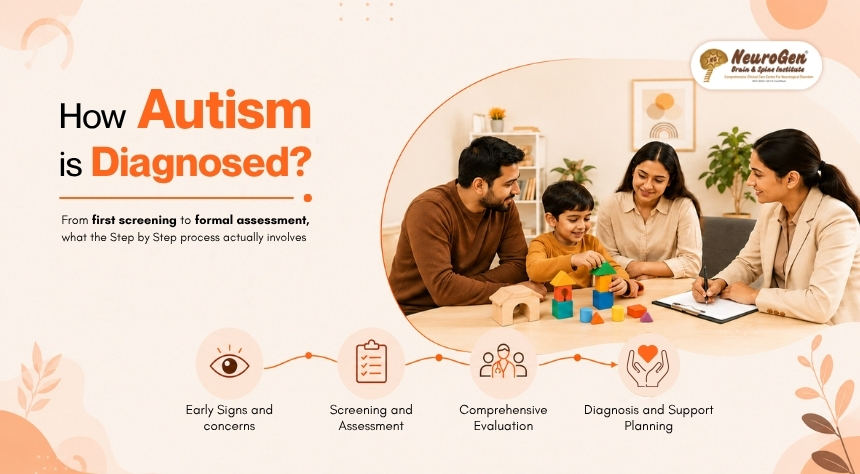
Autism diagnosis pathway
Every family’s experience is a little different, but the journey from first noticing something to starting support usually follows the same path:
Screening tools used for autism
Are screening tests enough to diagnose autism?
No. Screening only shows whether a fuller assessment is needed. A diagnosis is confirmed later, in a comprehensive evaluation.
Screening tools are short. Parents often fill them in, or a clinician runs through them with parents during assessment. They are built to be sensitive on purpose, which means they flag plenty of children for a closer look rather than risk missing one who needs help.
Table 1. Common autism screening tools and what they assess.
| Tool | Typical age | Format | What it looks at |
|---|---|---|---|
| M-CHAT-R/F | 16 to 30 months | Parent questionnaire with follow-up | Early social and communication behaviours in toddlers |
| SCQ (Social Communication Questionnaire) | About 4 years and older | Parent questionnaire | Social communication and repetitive behaviours |
| CSBS (Communication and Symbolic Behavior Scales) | Infancy to early childhood | Caregiver checklist and observation | Early communication and symbolic skills |
| ASQ (Ages and Stages Questionnaires) | 1 month to 5.5 years | Parent questionnaire | General developmental milestones, not autism-specific |
Comprehensive Diagnostic Evaluation tools
In a full evaluation, clinicians lean on a set of standardised instruments, sometimes called Comprehensive Diagnostic Evaluation tools, to give their observations some structure.
These tools support a clinician’s judgement; they do not replace it. The ones used at experienced centres, NeuroGen BSI included, usually feature the following.
Table 2. Standardised instruments used during a formal autism evaluation.
| Instrument | What it is | Typical age | Role |
|---|---|---|---|
| ADOS-2 (Autism Diagnostic Observation Schedule, 2nd Ed.) | A semi-structured, play and activity based session in which a clinician directly observes social interaction and communication | About 12 months to adulthood | A reference standard for direct observation |
| ADI-R (Autism Diagnostic Interview, Revised) | A structured, in-depth interview with parents or caregivers about behaviour and developmental history | Developmental level above about 2 years | Builds a detailed picture from caregiver report |
| CARS-2 (Childhood Autism Rating Scale, 2nd Ed.) | A clinician-completed rating scale based on observation and gathered information | From about 2 years | Helps gauge the presence and degree of autism characteristics |
| GARS-2/3 (Gilliam Autism Rating Scale) | A questionnaire-based scale completed by those who know the child, used to help identify autism and estimate severity | About 3 years and older | Supports identification and severity rating |
No single assessment uses all of them. A clinician picks the right tools for the person’s age, language, and how autism shows up in them.
Diagnostic criteria: DSM-5-TR and ICD-11
A diagnosis becomes official when what the clinician sees matches up with one of two recognised diagnostic criterias. The criterias may present differently in all individuals.
DSM-5-TR
The DSM-5-TR comes from the American Psychiatric Association and is used widely in clinics. It builds autism around two core areas, and both have to be present:
Ongoing differences in social communication and interaction across different settings. Think social give and take, body language like eye contact and gestures, and building and keeping relationships.
Restricted and repetitive behaviour, interests, or activities. Things like repeated movements or speech, a real need for routine and sameness, intense interests, and strong reactions to sensory input such as sound, texture, or light.
For a diagnosis, these need to have been there since early childhood, and affects their daily functioning, and to not be better explained by some other condition.
The DSM-5-TR also assigns a level of support required for quantifying the severity of these conditions, ranging from Level 1 (needs support) to Level 3 (needs very substantial support). It describes how much help someone needs, rather than sorting them into a type of autism.
One thing that leads to confusion for a lot of parents is that names like Asperger’s syndrome and PDD-NOS are no longer separate diagnoses. Since the DSM-5 arrived in 2013, they all sit under the one heading of autism spectrum disorder.
ICD-11
The ICD-11 is the World Health Organization’s system, used across India and much of the world. It files autism under the code 6A02. Instead of support levels, it uses subcategories that note whether there is an accompanying difficulty with intellectual development and how much functional language a person has. It gives clinicians a tidy way to record how autism shows up in one individual.
DSM-5-TR or ICD-11, does it matter for my child? In real life, both point to the same diagnosis. Which one your clinician reaches for usually comes down to where they work and which country they are in. What counts is that the evaluation is thorough and done by someone qualified.
At what age can autism be diagnosed?
Autism can be reliably diagnosed by around age two, and the earliest signs sometimes show up between 12 and 18 months. In practice, plenty of children are picked up later, well into the school years, especially when the signs are subtle or specialists are hard to reach.
There is no upper age limit. Teenagers and adults are diagnosed too, often after years of not quite knowing why social situations or sensory things felt harder for them. Getting there early opens the door to support sooner, but a later diagnosis still brings real understanding and real help.
Whatever the age, if something is nagging at you, it is worth raising rather than waiting.
Because autism stays with a person for life, this is often the point where families ask whether autism can be cured. The honest answer is that the goal is not a cure but building communication, skills, and independence over time.
Autism diagnosis in adults and children
The way autism is spotted does not really change with age. It always comes back to watching how someone communicates and connects, and piecing together their history.
What changes is who tells the story, and how much of it a person can tell about themselves.
With children
- Most of the picture comes from watching and from listening to parents, because a small child cannot always put into words how the world feels to them.
- A clinician notices the ordinary things: does the child turn to their name, how do they use eye contact and gestures, how do they play, and what have you been seeing at home.
- Tools like the M-CHAT-R/F and CARS give that watching some structure.
- The reason for catching it early is simple: the sooner support starts, the more room a child has to grow.
With adults
- Adults are often harder to read, and for a fair reason. Many grew up without anyone noticing, either because less was known back then or because they learned to blend in.
- Their assessment leans far more on their own reflections and the long story of their life, sometimes with a parent or partner filling in the early parts.
- The clinician is listening for patterns that have always been there, not for anything new, and looking under years of coping habits that can hide autism at a glance.
- Finding out later still matters. For many people it brings the relief of finally understanding themselves, and it can open up support that was never offered before.
Table 3. How autism assessment tends to differ for children and adults.
| What the assessment leans on | In children | In adults |
|---|---|---|
| Main source of information | Direct observation and caregiver report | Self-reflection and personal history, sometimes a relative’s account |
| Typical tools | M-CHAT-R/F, CARS, caregiver interview | Self-report questionnaires plus in-depth clinical interview |
| Key challenge | Child cannot always describe their experience | Masking and learned coping can hide the signs |
| Main benefit of diagnosis | Support begins while development is most flexible | Clarity, self-understanding, access to accommodations |
Autism in women and girls
Autism has been missed in girls and women for a long time, so many are only recognised much later. A few simple reasons explain most of it:
- Autism was mostly studied in boys, so the checklists were built around how boys present.
- Many girls and women hide it well. Known as masking, They copy the people around them, and their interests can look ordinary, so the signs slip past.
- Girls who are aloof and shy could be labeled as shy rather than recommended evaluation. Cultural and traditional gender roles of female could also impact the appropriate assessment amongst females.
- Their struggles are often felt on the inside, as anxiety or low mood, so autism gets looked at only after other things have been ruled out.
- The gap is slowly closing. The diagnosis ratio has moved from about 4 boys to every 1 girl down to nearer 3 to 1, and about 1 in 4 women are now diagnosed as adults rather than as children.
- This is why so many women find out in their teens or as adults, and why seeing someone who knows how autism looks in women makes such a difference.
Who can diagnose autism?
Autism should be diagnosed by someone qualified, or a team of them, with real training in child development and autism. Depending on where you are, that might be:
- Developmental paediatricians, who focus on how children grow and develop.
- Child and adolescent psychiatrists, who look at behaviour, development, and mental health.
- Paediatric neurologists, who check the nervous system and rule out related conditions.
- Clinical or child psychologists, who carry out the behavioural and cognitive testing.
- Multidisciplinary teams, which bring several of these together with speech and occupational therapists.
Your family doctor or paediatrician is usually the first port of call and can point you towards the right specialist.
A specialist centre offering autism diagnosis in India can bring all of these professionals under one roof.
Why early diagnosis matters
An early diagnosis does not change who your child is. What it changes is timing. It means the right understanding and the right support can begin sooner, while a young child’s brain is still developing quickly and is especially open to learning.
Recognising autism early tends to help in a few practical ways:
- Brain development. Young children’s brains are highly adaptable, so support introduced early can work with this natural flexibility.
- Access to therapies. A diagnosis opens the door to speech, occupational, and behavioural support suited to your child.
- Educational planning. Schools and teachers can put helpful adjustments in place sooner, so learning feels more manageable.
- Family support. Parents gain a clearer understanding of their child, practical day-to-day strategies, and access to support networks.
None of this is a race, and none of it promises a particular outcome. It simply means the people around a child have more time to help. Which leads naturally to the next question: what happens once a diagnosis is made?
What happens after an autism diagnosis?
A diagnosis is not the end of the road. It is the start of a clearer one. Once you know, the focus shifts to understanding your child’s strengths and needs and getting the right support in place.
Support is always individual, and therapy for autism spectrum disorder usually blends behavioural, communication, sensory, and educational approaches around the child.
The most important thing is simply to start. Early, steady, tailored support gives children the best chance to build skills and confidence over time.
Above all, try to hold on to this. A diagnosis does not decide your child’s future. It simply helps you understand them more fully, their strengths as much as their challenges, so the right support can begin at the right time. For most families, that understanding is the start of something hopeful, not the end of anything.
Common misconceptions about autism diagnosis
A lot of worry grows from ideas about autism diagnosis that are not true. Here are some of the most common, and what the evidence says.
- Myth 1: a blood test can diagnose autism. No blood test, brain scan, or genetic test can diagnose autism. It is identified through observation and developmental history.
- Myth 2: one screening questionnaire confirms autism. Screening tools only flag whether a fuller assessment is needed. A diagnosis is confirmed through a comprehensive evaluation.
- Myth 3: an MRI scan can diagnose autism. Brain scans cannot diagnose autism. They are sometimes used to rule out other conditions, not to confirm it.
- Myth 4: children always outgrow autism. Autism is a lifelong part of how a person develops. With support, children learn and grow, but they do not simply grow out of being autistic.
- Myth 5: only boys can be autistic. Autism occurs in girls and women too. It has often been missed in them, which is one reason many are diagnosed later.
- Myth 6: autism can only be diagnosed in childhood. Autism can be recognised at any age. Teenagers and adults are diagnosed too, often after years without an explanation.
Frequently asked questions
Is there a blood test for autism?
No. There is no blood test, brain scan, or genetic test that diagnoses autism. A diagnosis is based on watching behaviour and understanding developmental history. Medical tests are sometimes used to rule out other conditions or spot ones that occur alongside autism, but not to diagnose autism itself.
What age can autism be diagnosed?
Specialists can often diagnose autism reliably by around age two, and the earliest signs sometimes appear within the first 18 months. Many children are diagnosed later, and teenagers and adults can be diagnosed too.
Who can diagnose autism?
Qualified professionals such as developmental paediatricians, child psychiatrists, paediatric neurologists, or clinical psychologists, often working as a team. Your family doctor or paediatrician can refer you.
What tests are used to diagnose autism?
There is no single test. Clinicians use screening tools such as the M-CHAT-R/F, then Comprehensive Diagnostic Evaluation tools such as CARS-2, , GARS ADOS-2, and ADI-R,during a full assessment, read alongside developmental history.
How long does an autism assessment take?
It varies. Screening takes only 10 minutes, while a full diagnostic evaluation can run across one or more sessions and several hours, since it combines interviews, direct observation, and skill assessments.
Can autism be diagnosed in adults?
Yes. Adults are often diagnosed after recognising lifelong social, communication, or sensory differences. Adult assessment relies on the same principles of observation and personal history.
What is the difference between DSM-5-TR and ICD-11 for autism?
Both describe the same condition. The DSM-5-TR organises autism around two core areas with support levels, while the ICD-11 uses the code 6A02 with subcategories based on intellectual development and functional language. Which one is used usually depends on the clinician’s setting.
Sources & References
- Centers for Disease Control and Prevention (CDC), screening and diagnosis of autism spectrum disorder.
- World Health Organization, International Classification of Diseases, Eleventh Revision (ICD-11), code 6A02.
- American Psychiatric Association, Diagnostic and Statistical Manual of Mental Disorders, Fifth Edition, Text Revision (DSM-5-TR).
- Grosvenor LP, Croen LA, Lynch FL, et al. Autism Diagnosis Among US Children and Adults, 2011 to 2022. JAMA Network Open. 2024;7(10):e2442218.
- Epic Research. Diagnosis of Autism Occurring Earlier in Children, Though Still Late for Many; Initial Diagnosis in Adulthood Increasing in Women. 2025.